Safety Auditing Methodology | Procedure, Steps & Standards – Consultivo
Safety Auditing Methodology IS 14489 · ISO 45001 · ProtoSafe™

A Safety Audit Procedure
That Goes Deeper
Than a Checklist

Consultivo's safety auditing methodology is a rigorous, risk-based procedure — built on 2,000+ audits, validated proprietary protocols, and senior expert interpretation. Here is exactly how we do it.

30+
Elements assessed per audit
2K+
Audits completed
3 types
Improvement · Compliance · Due Diligence
19+
Countries served
Safety Audit Flow — Offsite → Onsite → Offsite
1
Pre-Audit PlanningScope, team assignment & document request
2
Opening MeetingAlign scope, confirm schedule with management
3
Physical WalkthroughAll plant areas, photo documentation
4
Document ReviewPolicies, records, permits, training logs
5
Personnel InterviewsExecutives, supervisors & operators
6
Closing MeetingPreliminary findings shared on-site
7
Analysis & ScoringRisk criticality: High / Medium / Low
8
Report DeliveryFull report in 10–15 working days
Safety Audit Definition

What Is Safety Auditing?

Safety auditing is a systematic, documented, and independent evaluation of an organisation's occupational health and safety (OHS) management systems, workplace practices, and compliance status against defined criteria.

A safety audit is conducted to identify gaps, confirm compliance with legal requirements, and provide management with the evidence needed to reduce OHS risks and drive continual improvement. It is distinct from a safety inspection — which focuses on immediate physical conditions — because a safety audit examines the entire system behind those conditions.

In India, safety auditing is governed primarily by IS 14489:2018, the Bureau of Indian Standards Code of Practice for OHS Audits, and is a statutory requirement under the Factories Act 1948 for most manufacturing and hazardous process facilities.

"Safety auditing is not a box-ticking exercise — it is a management tool that tells you where you truly stand, what the real risks are, and exactly what to do next."

A Safety Audit Is Conducted To:

  • Verify compliance with IS 14489, legal statutes, and applicable standards
  • Identify occupational health and safety risks before they cause incidents
  • Assess the effectiveness of the OHS management system holistically
  • Provide quantified, actionable recommendations for improvement
  • Support ESG reporting, insurance requirements, and investor due diligence
  • Enable management decision-making on priorities and resource allocation
  • Benchmark performance against global best practices and peer organisations
Types of Safety Audit

Three Types of Safety Audits — Matched to Your Purpose

The purpose of a safety audit defines which type is right for you. Consultivo delivers all three — each designed to answer a specific business question.

Improvement Audit

A consulting-led assessment of your current safety systems against global benchmarks, international standards, and industry best practices. Delivers a gap analysis with a prioritised improvement roadmap — not just a compliance verdict.

Ideal forNew site setups, post-incident reviews, ESG-driven safety benchmarking, proactive safety culture improvement

Also known as: As-Is Assessment · Gap Assessment · Baseline Safety Audit

Compliance Audit

A rigorous, evidence-based safety audit against IS 14489:2018, the Factories Act 1948, state factory rules, and all applicable statutes. Provides an independent, legally defensible compliance record with risk-rated findings.

Ideal forStatutory OHS audits, insurance requirements, customer and buyer audits, legal risk mitigation

Also known as: Statutory Safety Audit · IS 14489 Audit · OHS Legal Audit

Due Diligence Audit

A structured evaluation of OHS liabilities, regulatory compliance gaps, and safety system maturity — conducted as part of M&A transaction advisory. Identifies latent risks that affect deal terms, valuation, or post-acquisition integration.

Ideal forPre-acquisition reviews, investor due diligence, ESG due diligence, post-merger integration planning

Also known as: OHS Due Diligence · Safety M&A Audit · Transaction Safety Review

First-party, second-party, and third-party audits

Safety audits are classified by who conducts them. A first-party audit is self-conducted. A second-party audit is conducted by a customer on a supplier. A third-party audit — such as those conducted by Consultivo — is carried out by an independent, commercially unbiased external organisation, providing the highest level of credibility and objectivity.

Safety Audit Standards

Assessment Criteria & Applicable Standards

Every Consultivo safety audit is conducted against defined criteria. The applicable standards depend on the industry sector, audit type, and contract conditions.

Primary Indian Standards & Legislation

Core statutory requirements for India
  • ›IS 14489:2018 — Bureau of Indian Standards Code of Practice for OHS Audit (primary statutory basis)
  • ›Factories Act 1948 and applicable state factory rules
  • ›Mines Act and Mines Rules — for mining sector audits
  • ›Gas Cylinder Rules, SMPV Rules, Petroleum Rules, MSIHC Rules
  • ›State Fire Service Acts and fire-fighting equipment standards (IS-2190, IS-2189, IS-636)
  • ›CEA Safety Regulations, Indian Electricity Rules 1956, IS 3043
  • ›National Building Code (NBC) 2016, NFPA 101 Life Safety Code
  • ›MV Act / CMVR Rules (for logistics and fleet audits)

International Standards & Best Practices

Applied in ProtoSafeâ„¢ quantified assessments
  • ›ISO 45001:2018 — International OHS Management System standard
  • ›IFC Performance Standard 2 — World Bank Group labour and working conditions
  • ›IFC/World Bank EHS Guidelines (General and sector-specific)
  • ›NFPA standards (NFPA 70E, NFPA 780, NFPA 13, NFPA 101)
  • ›OSHA standards and guidelines (US)
  • ›OISD (Oil Industry Safety Directorate) standards
  • ›HSE UK guidance and codes of practice
  • ›FM Global, CDC/NIOSH, and sector-specific industry good practices

What is IS 14489?

IS 14489:2018 is the Code of Practice for Occupational Health and Safety Audit published by the Bureau of Indian Standards (BIS). It is the primary statutory basis for safety audits across Indian industry. Consultivo's auditors are trained and experienced in IS 14489 and have conducted IS 14489 safety audits across process plants, refineries, cement plants, mines, construction sites, commercial buildings and warehouses. Read our guide on the 8 common IS 14489 mistakes →

Safety Audit Procedure

How Consultivo Conducts a Safety Audit

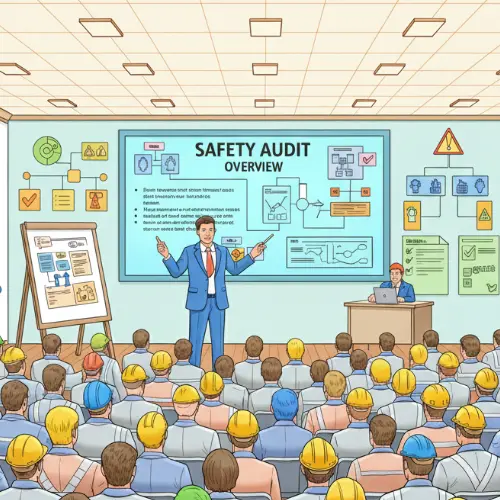
The safety audit procedure follows a structured three-phase approach — offsite preparation, onsite execution, and offsite analysis and reporting. Every step is documented and traceable.

Phase 1
Offsite — Pre-Audit
Phase 2
Onsite — Audit Activities
Phase 3
Offsite — Analysis & Report
1
Pre-Audit · Offsite

Study of the Plant, Facility & Processes

Before setting foot on site, the audit team studies the plant or facility — its processes, industry sector, applicable legal requirements, previous audit findings (if available), and specific client expectations. The audit scope is formally defined, the appropriate protocol selected (IS 14489 or ProtoSafe™), and a competent team is assigned with relevant sector experience.

Scope definition Protocol selection Team assignment Document request shared
2
Onsite

Opening Meeting with Senior Management

The audit begins with a formal opening meeting. The audit team introduces themselves, confirms the scope and methodology, explains what the audit will and will not cover, and aligns on the on-site schedule. This is an opportunity for the client management team to highlight any specific areas of concern or context the auditors should be aware of.

Scope confirmation Schedule alignment Introductions
3
Onsite

Physical Walkthrough of All Plant Areas

The audit team conducts a systematic physical tour of all relevant plant areas, departments, and operational zones. Auditors observe working conditions, equipment states, safety signage, housekeeping standards, and on-the-ground implementation of safety procedures. All observations are documented in real time with photographic evidence using the ESGSlate platform.

All units and areas Photo documentation Hazard identification ESGSlate data capture
4
Onsite

Document and Record Review

Auditors examine the documentary evidence behind safety systems — OHS policies, risk assessments, safety inspection records, incident reports, training registers, permit-to-work systems, equipment inspection logs, and legal compliance registers. Documents are reviewed for completeness, currency, and evidence of actual implementation rather than mere existence.

Safety policies Risk assessments (HIRA) Training records Incident reports Compliance registers
5
Onsite

Personnel Interviews at All Levels

Safety auditing is not only about what is written or what is visible — it is about what is actually practised. Structured interviews are conducted with executives, safety officers, supervisors, and front-line operators to assess safety awareness, understanding of procedures, and the practical implementation of the safety management system. Discrepancies between documented systems and actual practice are critical audit findings.

Executives & management Safety team Supervisors Operators & workers
6
Onsite

Closing Meeting with Management

Before leaving the site, the audit team presents preliminary findings to the client's senior management team. This gives management the opportunity to clarify factual matters, provide additional context, or raise questions about specific observations. The closing meeting ensures there are no surprises in the final report — and begins the process of ownership of the findings.

Preliminary findings shared Management Q&A Clarifications
7
Post-Audit · Offsite

Data Analysis, Scoring & Risk Assessment

All collected data — quantitative scores from ProtoSafe sub-elements and qualitative observations — are analysed off-site by the audit team. Each of the 30 major OHS elements is scored against the maximum, and risk criticality (High, Medium, or Low) is assigned to every identified gap based on potential severity and likelihood. Fully compliant sub-elements are confirmed accordingly.

30-element scoring High / Medium / Low risk Maturity rating Senior expert review
8
Post-Audit · Offsite

Report Preparation and Delivery

The final safety audit report is prepared by the team and reviewed by a senior domain expert (30+ years of experience) before delivery. The report includes the executive summary, dashboard, element-wise scores, detailed findings, recommendations against each gap, photo gallery, and annexures. Draft and final reports are delivered within 10–15 working days of the site visit. An optional virtual report walkthrough session is available.

Executive summary Dashboard & charts Findings & recommendations Delivered in 10–15 days

Who Conducts the Audit

Project Manager

Dedicated project manager overseeing planning, scheduling, on-site coordination, and timely report delivery.

Technical Audit Team

Qualified auditors with 15+ years of hands-on experience, matched to the industry sector and audit scope.

Review & Mentor Expert

The entire process is reviewed by an independent domain specialist with 30+ years of experience — fire, electrical, process, or safety as relevant.

ProtoSafeâ„¢ Protocol

The Assessment Protocol Behind Every Quantified Audit

ProtoSafe is Consultivo's proprietary quantified safety assessment protocol — validated through 2,000+ audits across 30+ industry sectors. It goes well beyond IS 14489 compliance to deliver a scored, benchmarkable, and visually rich picture of OHS maturity.

ProtoSafe covers 30 major elements including:
E1–E3OHS Policy · Leadership · Training
E7–E10Compliance · Equipment · HIRA
E16–E18Machine guarding · Electrical · General conditions
E22–E24Fire systems · Emergency plans · Plant safety
E29–E30Contractor safety · Mining safety
+25 moreSub-elements per major element

ProtoSafe Assessment Criteria

  • ✓IS 14489:2018 — all requirements
  • ✓Factories Act 1948 & state rules
  • ✓ISO 45001:2018 management system elements
  • ✓IFC / World Bank EHS Guidelines
  • ✓NFPA, OSHA, OISD, HSE UK, FM Global
  • ✓Industry sector best practices
  • ✓Multi-plant benchmarking
  • ✓Star-rated maturity scoring (1–5 stars)
  • ✓Top 5 & bottom 5 element identification
  • ✓Dashboard with graphical representation
Available for sectors including:
Manufacturing Process Plants Commercial Buildings Warehouses Mines Construction Sites Refineries
Safety Audit Report

What the Safety Audit Report Contains

The safety audit report is not simply a list of findings — it is a management decision-making tool. Every Consultivo report is structured, visual, and immediately actionable.

The report is the tangible output of the safety auditing process. It translates the data collected during field activities into prioritised, interpretable insights that help management decide the next steps, set priorities, allocate resources, and build a risk reduction plan.

Report Structure — All Consultivo Safety Audit Reports Include:

A
Project Details, Scope, Criteria & MethodologyConfirms what was audited, against which standards, by whom, and how
B
Executive Summary with Graphical AnalysisOverall score, star rating, top 5 elements, bottom 5 elements, and a comprehensive overview of the safety management system
C
Detailed Findings — Compliance & Non-ComplianceFindings against each requirement, with risk criticality level and allocated vs. achieved scores
D
Practical RecommendationsActionable recommendations against each identified gap — prioritised by risk level
E
Photo GalleryAnnotated photographs of note-worthy efforts and gaps — helping management understand the reality on the ground
F
ConclusionSummary of key strengths, critical areas of concern, and priority actions
G
AnnexuresSupporting data, checklists, references, and additional evidence
Element Score Dashboard (sample)
66.1%
Overall Score · 3 Stars
OHS Policy & Leadership
86.7
Emergency Preparedness
73.3
Fire Prevention Systems
70.0
Machine & Area Guarding
33.3
Contractor Safety Systems
33.3
HIRA & Risk Control
40.0
1★ Below 50%
2★ 50–65%
3★ 66–80%
4★ 81–95%
5★ 96–100%

Sample: Scored Assessment Findings

Observation Criticality Allotted Achieved
NOC from fire service not available at audit High 107
Machine guards absent at 6 belt conveyors High 104
Fire extinguisher coverage gap in cable gallery Medium 107
PASS instructions absent from extinguisher locations Low 106
What You Get

How a Safety Audit Supports Management Decision-Making

The safety audit report is a management tool. It provides the inputs your leadership team needs to act with confidence on safety.

Clarity on Next Steps

Prioritised recommendations tell you exactly what to do, in what order, to reduce risk — removing ambiguity from safety improvement planning.

Risk Prioritisation

High, Medium, and Low risk classifications against every finding — so resources are directed to the highest-impact safety improvements first.

Resource Allocation Evidence

A scored, visual report provides management with objective evidence to justify capital allocation for safety improvements to boards and leadership teams.

Year-on-Year Benchmarking

Repeated ProtoSafe audits provide a consistent scoring baseline, enabling measurable tracking of safety performance improvement over time.

Frequently Asked Questions (FAQs)

Questions? We have answers.

What is safety auditing?

Safety auditing is a systematic, documented, and independent process of evaluating an organisation’s occupational health and safety (OHS) management systems, practices, and compliance against defined criteria such as IS 14489, ISO 45001, and applicable legal requirements. It identifies strengths, weaknesses, gaps, and risks — providing management with the evidence needed to make informed safety decisions and demonstrate due diligence.

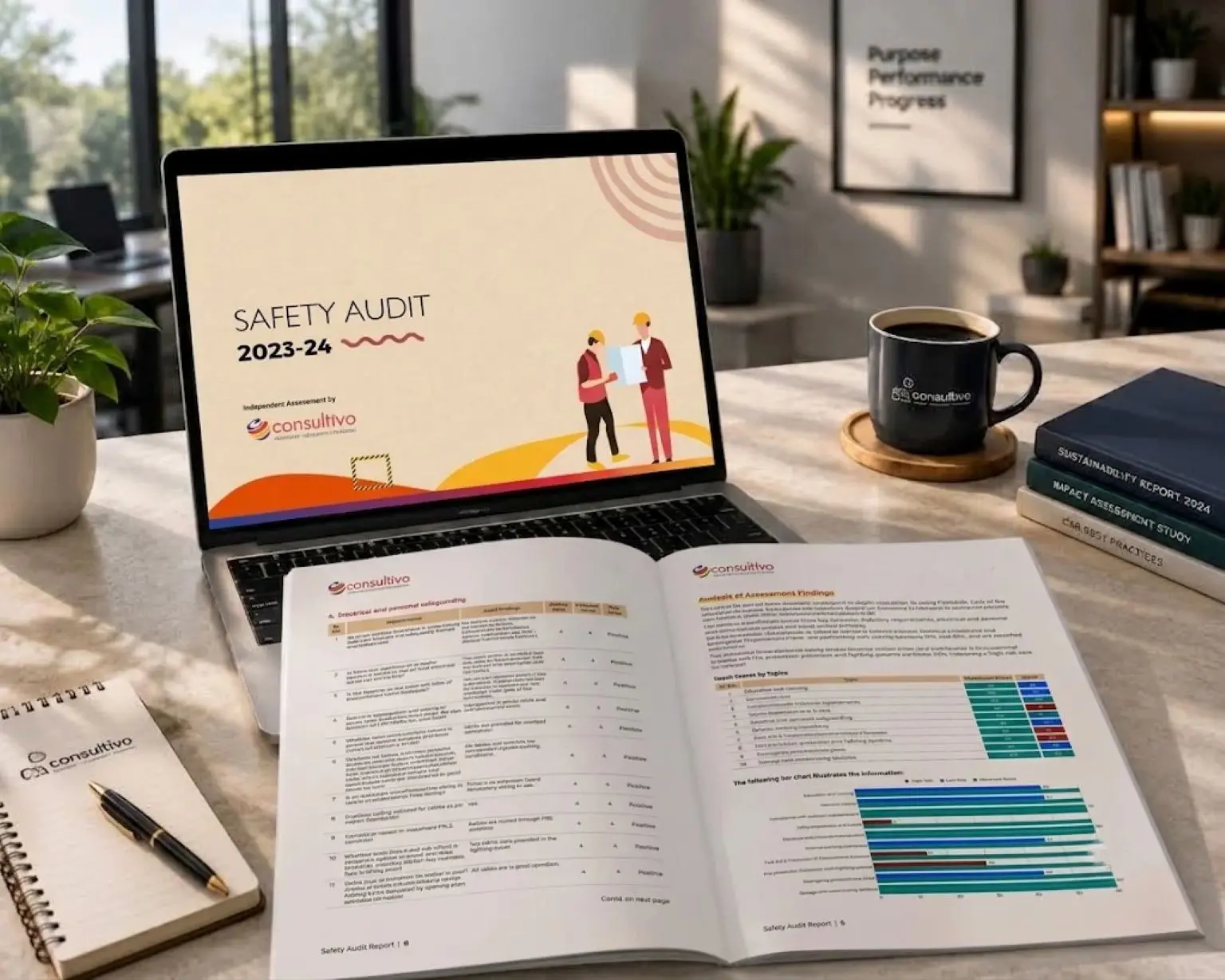
The safety audit procedure involves three phases: (1) Offsite pre-audit — study of the facility, scope definition, team assignment, and document requests; (2) Onsite audit activities — opening meeting, physical walkthrough, document review, personnel interviews at all levels, and a closing meeting with management; (3) Offsite post-audit — data analysis, risk scoring, senior expert interpretation, and report preparation and delivery within 10–15 working days.
 

A Consultivo safety audit report follows a structured format: (A) Project details, scope, criteria and methodology; (B) Executive summary with graphical analysis, overall score, and star rating; (C) Detailed findings against each requirement with risk criticality and scores; (D) Recommendations against each finding; (E) Photo gallery with annotated evidence; (F) Conclusion; (G) Annexures. For ProtoSafe audits, element-wise and sub-element-wise scoring dashboards are included.

The primary safety audit standard in India is IS 14489:2018 (BIS Code of Practice for OHS Audit). Beyond this, audits may reference the Factories Act 1948, state factory rules, Gas Cylinder Rules, SMPV Rules, Petroleum Rules, CEA Safety Regulations, National Building Code 2016, and sector-specific legislation. Internationally, ISO 45001:2018, IFC/World Bank EHS Guidelines, NFPA, OSHA, OISD, and HSE UK standards are also applied — especially in ProtoSafe quantified assessments.

The purpose of a safety audit is threefold: (1) to verify compliance with statutory and legal requirements; (2) to assess the effectiveness of the OHS management system; and (3) to identify risks and gaps before they result in incidents. Safety audits also support ESG reporting, insurance requirements, investor due diligence, and management decision-making on priorities and resource allocation.

There are three main types by purpose: (1) Improvement Audit — a consulting-led gap assessment against best practices, ideal for continuous improvement; (2) Compliance Audit — a statutory audit against IS 14489, the Factories Act, and legal requirements, ideal for regulatory compliance; (3) Due Diligence Audit — for M&A transactions, identifying OHS liabilities and system maturity. By party, audits are classified as first-party (internal), second-party (customer), or third-party (independent external like Consultivo).

Under the Factories Act 1948 and IS 14489:2018, a safety audit report must document the scope of the audit, the criteria used, the findings against each requirement (including compliance and non-compliance), and recommendations for corrective action. The report must be prepared by a competent, independent third party with no conflict of interest. Consultivo’s IS 14489 audit reports are structured to meet these statutory requirements and are accepted by regulatory authorities, insurers, and customers.

A safety inspection focuses on immediate physical conditions — identifying visible hazards and checking equipment. A safety audit is broader and deeper: it examines the entire OHS management system, including policies, procedures, training, leadership, documentation, legal compliance, and the culture behind the conditions. An audit asks “why does this condition exist?” — an inspection records that it does. Regular inspections are a component within a safety management system; a safety audit evaluates whether the whole system is working.

About Consultivo

Consultivo is one of the leading ESG Consultants in India

An Advisory, Research, Audit & Training organisation helping global businesses in the areas of Sustainability, Business Excellence & Risk Management both at the strategic and operational levels.

Major service verticals include Safety, Sustainability, Environment & Energy, CSR, Management Systems, Organisational Development and Human Capital Development. Consultivo works with 100+ National and International Sustainability related codes, standards and guidelines.

Apart from Independent External Assurance, as a leading ESG Consultant based in India, Consultivo offers ESG Materiality Assessment and Strategy Consulting ESG Implementation Handholding, Stakeholder Mapping and Engagement, ESG, Sustainability and BRSR Report Preparation and ESG Report Design.

Consultivo Academy offers training and capacity building services both in conventional and new age e-learning platforms.

Leading in independent fire safety solutions - pan India

10+

Solutions

600+

Customers

30+

Industry Sectors

1000+

projects In total

22+

States

10+

Languages

Our Presence

Resources at strategic locations PAN India Mumbai, Kochi, Thane, NCR, Indore, Bengaluru, Chennai, Kolkata, Visakhapatnam, Guwahati, Jamshedpur

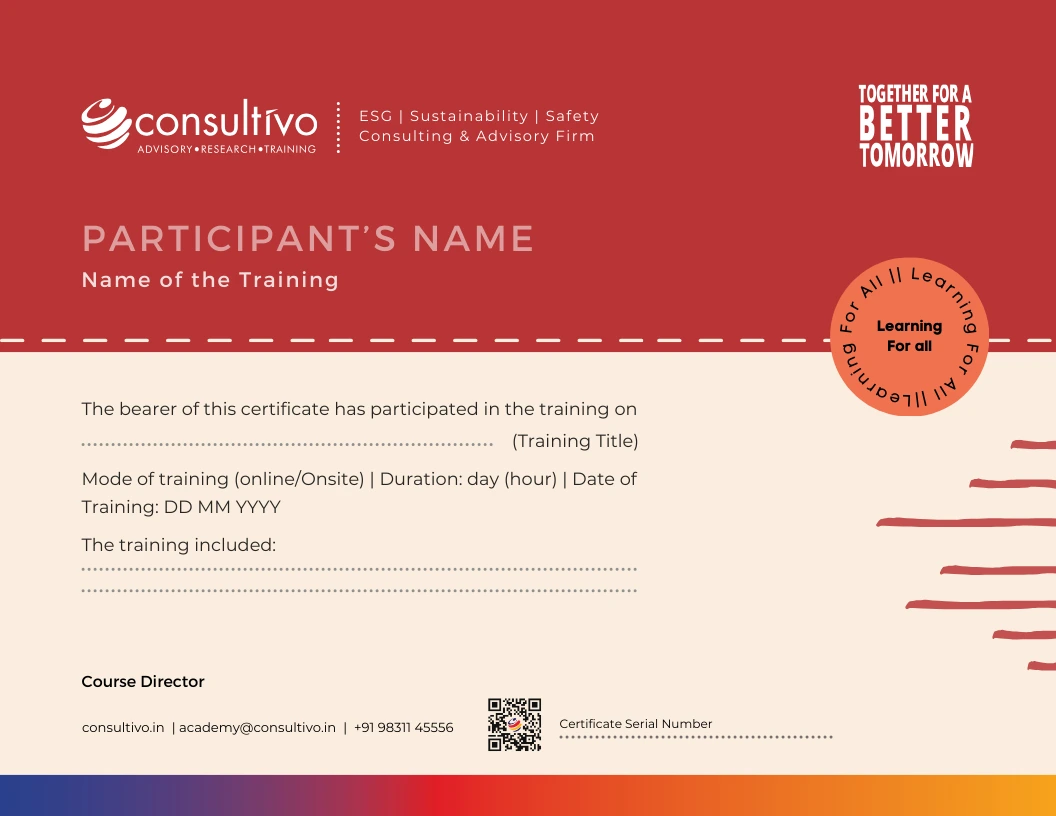
Consultivo Academy Training Certificate

QUALIFICATION, AWARENESS & COMPETENCE BUILDING

Online and Onsite Courses: Use our Training and Capacity Building expertise in Sustainability, CSR, Social Responsibility, and Social Governance.

Browse our Impact Stories

Read a few of our stories as we partner organisations as an ESG and Sustainability Due Diligence Audit Firm.

Fire Safety Auditing in Solvent-Based Chemical Industries

Ensuring safety in solvent-based industries: Comprehensive fire safety audits for risk prevention and compliance

Browse our Featured Blog

Read a few of our stories as we partner organisations as an ESG, Sustainability and People Advisory Consulting  Firm.

Safety Rules and Regulations in India NBC 2016

Guardians of Compliance: A Deep Dive into India’s Fire Safety Rules and Regulations

Dive into India's fire safety rules and regulations with our blog. Uncover the crucial details that make you a guardian of compliance. Stay informed, stay safe.

Powered by ESG Slate — Consultivo’s AI-driven audit engine.

For enquiries, email

or use the contact form to request a scoping call.

Let's discuss

100+

Solutions

ESG Materiality Assessment Training

Online Expert-Led Course

Consultivo BRSR Query Hub

Have a question as you wrap up SEBI BRSR 2025?

Consultivo and Slate of Swan wish you joy and cheer this festive season.