Consultivo · HIRA in Safety · ISO 45001 Requirement
Hazard Identification and Risk Assessment (HIRA) in Safety
HIRA is the systematic process of identifying workplace hazards, evaluating the level of risk each presents, and determining the controls needed to reduce that risk to an acceptable level. It is the foundation of every safety management system and a core requirement of ISO 45001. Consultivo conducts professional HIRA studies for all industries across India.
HIRA Full Form in Safety
What HIRA Stands For
Hazard
Any source with potential to cause harm: physical, chemical, biological, ergonomic or psychosocial.
Identification
The systematic process of finding, listing and characterising all hazards in a workplace or activity.
Risk
The combination of the likelihood that a hazard causes harm and the severity of that harm: Risk = Likelihood × Severity.
Assessment
Evaluating the level of risk to determine what controls are needed and how urgently.
Also written as: HIRA in safety, HIRA study, HIRA analysis, HIRAC, Heera in safety. Also called Hazard and Risk Assessment, or simply Risk Assessment under ISO 45001. Standards: ISO 45001:2018 Clause 6.1.2 (requires hazard identification and OHS risk assessment), ISO 31000:2018, IS 14489:2018, and the Factories Act 1948 with state safety rules.
Understanding HIRA
What Is HIRA in Safety, and Why It Matters
If you searched for "HIRA" expecting the Housing Industry Regulatory Authority, this page covers the safety meaning. For occupational safety HIRA services, you are in the right place.
Hazard identification and risk assessment is the cornerstone activity of any safety management system. Before you can control a risk, you have to know it exists, and before you know it exists, you have to systematically look for it.
HIRA is not a one-time exercise. It is an ongoing, structured programme, conducted when activities, processes or workplaces change, when incidents occur, when new equipment is introduced, and on a regular review cycle. ISO 45001 clause 6.1.2 makes it mandatory for any organisation running an OHS management system, as set out in ISO 45001:2018.
The output of a well-conducted HIRA is a HIRA register, a living document listing every identified hazard, its risk rating and the controls required. That register drives Safe Work Procedures, emergency preparedness plans, training needs and management programmes. HIRA sits within a wider process safety management approach and, at process level, alongside process hazard analysis consultants.

HIRA Risk Matrix: Likelihood × Severity
| Likelihood ↓ / Severity → | 1 Trivial | 2 Minor | 3 Moderate | 4 Major | 5 Catastrophic |
|---|---|---|---|---|---|
| 5 Very Likely | 5 | 10 | 15 | 20 | 25 |
| 4 Likely | 4 | 8 | 12 | 16 | 20 |
| 3 Possible | 3 | 6 | 9 | 12 | 15 |
| 2 Unlikely | 2 | 4 | 6 | 8 | 10 |
| 1 Rare | 1 | 2 | 3 | 4 | 5 |
HIRA formula: Risk = Likelihood × Severity. The standard 5x5 risk matrix used in industry HIRA studies.
The 4 Steps of HIRA
What Are the 4 Steps of HIRA in Safety?
Every HIRA, whatever the industry or tool, follows the same four-step logic. This is the foundation of using HIRA effectively as a safety management tool.
Hazard Identification
Systematically identify every source of harm: physical, chemical, biological, ergonomic and psychosocial, across every activity and area. A hazard that is not identified cannot be controlled. Output: a complete hazard inventory.
Risk Evaluation
For each hazard, assess likelihood and severity and multiply them on the risk matrix to produce a rating: Low, Medium, High or Extreme. Output: a risk-rated hazard list by priority.
Control Identification
Determine the right control for each risk using the hierarchy of controls, then split controls into management programmes, safe work procedures and emergency plans. Output: a HIRA register with a control plan.
Implementation and Review
Implement controls, develop SWPs, train the workforce, then review the HIRA when conditions change, after incidents and on a periodic basis. Output: controls in active use.
Hierarchy of Controls
How HIRA Determines the Right Control
Once a risk is rated, the control is not chosen arbitrarily. It is selected by working down the hierarchy of controls, from most effective to least. A common failure is jumping straight to PPE because it is cheap; we always explore higher-order controls first and document the justification when a lower-order control is chosen.

Elimination
Remove the hazard entirely from the workplace, the most effective control.
Substitution
Replace the hazardous substance, process or equipment with something less hazardous.
Engineering Controls
Physical barriers, guarding, ventilation or isolation that reduce exposure without relying on behaviour.
Administrative Controls
Safe work procedures, training, signage, permits to work and job rotation. SWPs sit here and are a direct output of HIRA.
Personal Protective Equipment
Helmets, gloves, respirators and harnesses. PPE protects the worker but does not remove the hazard.
Consultivo HIRA Service
How Consultivo Conducts Your HIRA Study
End-to-end HIRA facilitation, from methodology and team formation through onsite hazard identification, risk evaluation, control planning and HIRA register development, aligned with ISO 45001 Clause 6.1.2 and ISO 31000. Internal teams are often too close to their own workplace to see hazards clearly. Our independent professionals find the hazards internal teams miss and challenge assumptions that have become normalised.

Team Formation and Facilitation
We help you form the right HIRA team, workers, supervisors, maintenance, EHS and management, and facilitate so all voices are heard and all hazards surface.
Structured Hazard Identification
Walk-through surveys, task observation, incident history review and structured checklists, using techniques matched to your industry and hazard profile.
Risk Evaluation and Register
Risk scoring on the 5x5 matrix, categorisation, and a complete HIRA register, the primary output document of the study.
Control Plan
For each significant risk, the control type, the responsible owner and a completion timeline, spanning management programmes, SWPs and emergency plans.
What Makes Our HIRA Service Different
Practical and operational
Conducted by safety professionals with real industry experience, not desk-based consultants. We understand how work actually happens.
Skilled and independent
Experienced OHS professionals with cross-industry exposure and no commercial interest in any control or equipment.
ISO 45001 and ISO 31000 aligned
Structured to meet ISO 45001 Clause 6.1.2, with risk methodology aligned to ISO 31000. Your register is audit-ready.
Customisable
Risk matrix calibrated to your industry, HIRA format adapted to your safety management system, engagement scaled to you.
Actionable outputs
The register is a live action plan, not a report to file. Every risk has a control, an owner and a deadline.
Extensible
The study can extend into SWP development and emergency preparedness planning, a complete risk management system from one engagement.
HIRA vs JHA / JSA
Difference Between HIRA and JHA or JSA
Both are hazard identification tools, but they work at different levels. HIRA is the broader, area or activity-level assessment that produces a risk register for safety management. A job hazard analysis (JHA), also called job safety analysis (JSA), is a task-level tool that breaks a specific job into steps and identifies the hazard and control at each one, feeding directly into Safe Work Procedures. Consultivo conducts both.
| HIRA, Hazard Identification and Risk Assessment | JHA / JSA, Job Hazard or Safety Analysis | |
|---|---|---|
| Level | Area or activity-level, covering all hazards in a work area or process | Task-level, one specific job broken into sequential steps |
| Scope | Broad, across a facility, department or operation | Narrow, focused on one job or activity, very granular |
| Output | HIRA register: risk-rated hazard list with a control plan and actions | Job-specific hazard list and step controls, feeding an SWP |
| Used for | Safety planning, ISO 45001 compliance, management review, audits | Developing SWPs, pre-job planning, permit-to-work preparation |
| ISO 45001 | Clause 6.1.2, a mandatory requirement | Embedded within HIRA and SWP requirements |
Industry Coverage
HIRA Studies Across Every Industry Sector
The HIRA process is universal, but the hazards, standards and risk-matrix calibration vary by industry. Our team assigns sector-specific experts to each engagement.
Manufacturing
Machine and equipment hazards, chemical hazards in process, manual handling and ergonomics, and electrical and energy hazards.
Construction
Working at height, excavation and ground works, lifting and crane operations, and confined spaces on site.
Mining
Ground stability and strata, blasting and explosives, equipment and transport hazards, and dust and gas exposure.
Chemicals and Petrochemicals
Process hazard analysis consultants at process level, toxic and flammable material hazards, fire and explosion risk, and contractor permit-to-work HIRA.
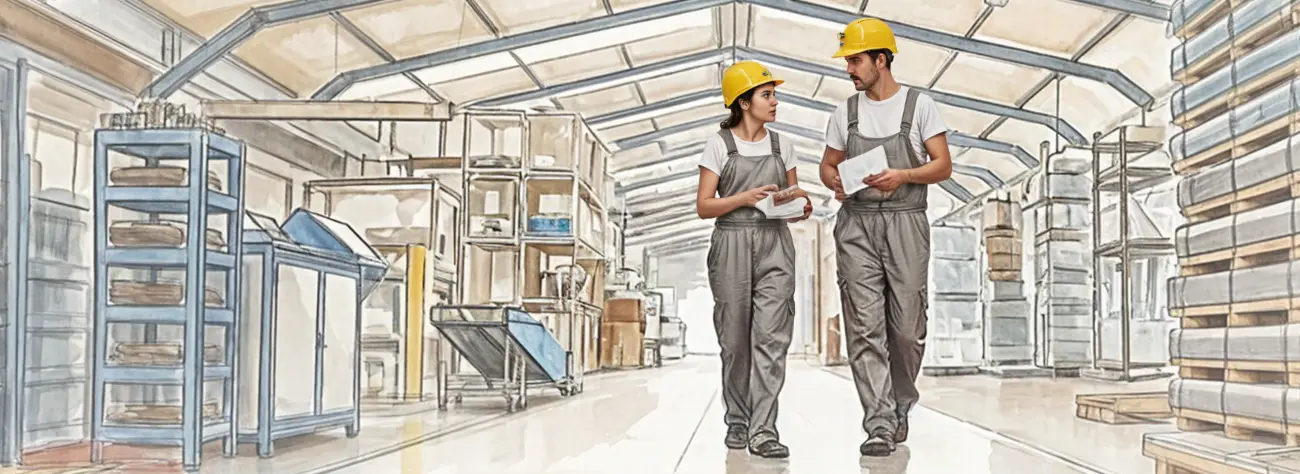
Logistics and Warehousing
Vehicle and pedestrian conflict, racking and storage failures, manual handling, and road and journey safety.
FAQ
Frequently Asked Questions
What is HIRA in safety, and what is the full form of HIRA?
HIRA stands for Hazard Identification and Risk Assessment. It is the systematic process of identifying workplace hazards, evaluating the risk level of each (using Risk = Likelihood × Severity), and identifying the controls needed to reduce risk to an acceptable level. It is a core requirement of ISO 45001:2018 Clause 6.1.2 and the foundation of any effective safety management system. It is also written as HIRAC, and common alternate spellings include "heera in safety" and "hira study".
What are the 4 steps of HIRA?
The four steps are: (1) Hazard Identification, systematically identifying all sources of harm; (2) Risk Evaluation, assessing likelihood and severity on a risk matrix to produce a rating; (3) Control Identification, choosing controls by the hierarchy of controls (Elimination, Substitution, Engineering, Administrative, PPE); and (4) Implementation and Review, putting controls in place with owners and timelines and reviewing them periodically.
What is the HIRA formula in safety?
Risk = Likelihood × Severity, also expressed as Probability × Consequence. Likelihood is rated 1 to 5 (1 Rare, 5 Very Likely) and Severity 1 to 5 (1 Trivial, 5 Catastrophic). The product gives a score from 1 to 25: 1 to 4 Low, 5 to 9 Medium, 10 to 16 High, and 17 to 25 Extreme. This is the standard 5x5 HIRA risk matrix used across Indian industry and aligned with ISO 45001.
What is a HIRA register?
A HIRA register is the primary output of a HIRA study. It is a structured document that lists every hazard, its location and source, the risk rating, the existing controls, the residual risk, the additional controls required, the responsible owner and the target date. It is a living document, reviewed and updated when conditions change, after incidents, and on a periodic basis, in line with ISO 45001 Clause 6.1.2.
What is the difference between HIRA and JHA or JSA?
HIRA is a systematic, area or activity-level assessment covering all hazards across a work area, process or operation, producing a risk register for planning and management. A job hazard analysis (JHA) or job safety analysis (JSA) is a task-level tool that breaks a specific job into steps and identifies the hazard and control at each, feeding directly into Safe Work Procedures. HIRA is the broader programme, JHA or JSA is the task-specific tool within it. Consultivo conducts both.
What is HIRAC in safety?
HIRAC stands for Hazard Identification, Risk Assessment and Control, an extended form of HIRA that names the control step explicitly in the acronym. It is common in Australia, New Zealand and some sectors in India, and covers the same process: identify hazards, assess risk, and determine and implement controls. Consultivo uses the HIRA terminology as it is more prevalent in India, but the methodology is identical.