

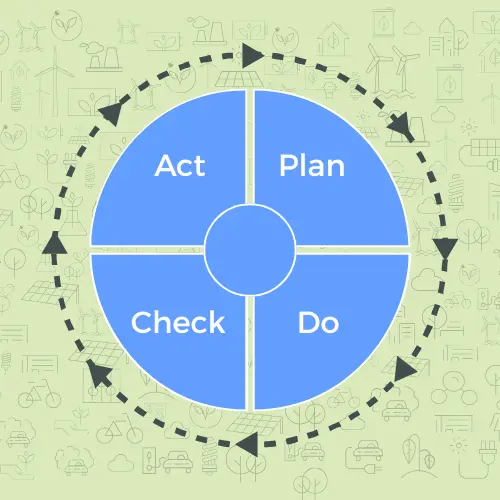
The PDCA cycle (Plan-Do-Check-Act) is more than just a quality tool; it’s the fundamental framework guiding modern management systems globally, including all major ISO standards.
This simple, elegant plan do check act cycle provides a structured PDCA approach for continuous improvement in any process or business hypothesis.
The PDCA cycle remains the foundational “old gold” of effective management.
By understanding its origins, integrating it with modern technology, and using disciplined tools like A3 Thinking and the 5 Whys, organisations can ensure their plan do check act cycle drives genuine, perpetual improvement.
Origin of PDCA Cycle and the Old Story
The Concept’s True Originator
The foundational concept of PDCA originated with Walter A. Shewhart, an American physicist and statistician, in the 1930s.
- He initially conceived of a three-step process: Specification to Production to Inspection.
- Later, he developed the concept of the “Shewhart Cycle” for statistical quality control, often described as a repetitive cycle of “Plan, Do, and See.”
PDCA Cycle: The Japanese Connection (Deming’s Role)
The most famous story involves W. Edwards Deming, Shewhart’s student and colleague, who heavily promoted the concept in Japan in the 1950s.
- Deming introduced the cycle (which he called the Shewhart Cycle to the Japanese Union of Scientists and Engineers (JUSE).
- JUSE, recognizing the power of the framework, adapted the final “See” step to “Check” and “Act”, resulting in the now-famous Plan-Do-Check-Act (PDCA) model or PDCA approach.
In Japan, it became known as the Deming Wheel or Deming Cycle, especially after Deming’s influential work in post-war Japanese quality management. Deming himself later preferred the term “Shewhart Cycle.”
The Classic Story of PDCA Cycle: Simple Continuous Improvement
The “old story” emphasizes its function as a simple, iterative method for process control and continuous improvement (Kaizen).
Full Form of PDCA Cycle: What Each Step Means
The full form of PDCA outlines the iterative process:
- P – Plan: Identify an opportunity, define the goals, and plan the change.
- D – Do: Implement the change on a small scale (pilot test).
- C – Check: Measure the results, compare against the plan, and analyze the effectiveness.
- A – Act: Standardise the change if successful, or abandon/refine the plan and restart the PDCA approach.

Start your ISO Consulting journey
New Perspectives on the PDCA Cycle
The PDCA cycle has evolved beyond factory floors, adapting to the demands of rapid innovation and digital transformation.
PDCA Approach in the Modern Industrial World (Industry 4.0)
In the era of Industry 4.0, the PDCA approach integrates advanced technology for unprecedented speed and precision:
| PDCA Stage | Industry 4.0 Application | Benefit |
|---|---|---|
|
PLAN |
Predictive Analytics & Digital Twins. Use Big Data and AI to simulate the potential impact of a change before implementing it. |
Reduces Risk: Plans are based on simulated future outcomes, not just historical data. |
|
DO |
Automated Execution & IoT. Use IoT sensors and robotic systems to implement the change on a small scale precisely and consistently. |
Precision & Speed: Changes are executed with minimal human error and maximum control. |
|
CHECK |
Real-Time Data Analytics & Machine Learning. Continuously stream performance data from the process and use ML algorithms to detect deviations instantly. |
Immediate Feedback: Evaluation is instant and objective, replacing delayed manual audits. |
|
ACT |
Closed-Loop Control & System Autonomy. Automatically adjust process parameters or trigger new improvement cycles based on Check results without human intervention. |
True Continuity: Improvement becomes an autonomous, systemic function. |
The PDCA Approach in Agile and Lean Management
PDCA principles are deeply embedded in modern methodologies beyond traditional quality management:
- Lean Management: The concept of continuous improvement (Kaizen) is inherently PDCA.
- Agile/Scrum: The Sprint Cycle in Scrum is a form of PDCA:
- Plan: Sprint Planning.
- Do: Sprint Execution.
- Check: Sprint Review and Retrospective.
- Act: Incorporating lessons into the next Sprint.
PDCA and Risk-Based Thinking
Newer ISO standards heavily emphasize risk-based thinking, which fits perfectly into the “Plan” stage.
- Plan: The planning process must include identifying risks and opportunities related to the system’s goals before any action is taken. This proactive risk assessment strengthens the entire cycle.
Integration into ISO Standards (The High-Level Structure)
ISO standards (like ISO 9001, 14001, 45001) use PDCA as their fundamental structure, often called the High-Level Structure (HLS) or Annex SL.
- This elevated PDCA from a shop-floor tool to a strategic management framework.
- The clauses of these standards map directly to the cycle:
- Plan: Context of the Organization, Leadership, Planning, Support.
- Do: Operation.
- Check: Performance Evaluation.
- Act: Improvement.
ISO 31000: The PDCA Framework for Risk
The application of the PDCA cycle in the ISO 31000 Risk Management Framework (Clause 5) and the Risk Management Process (Clause 6) is as follows:
| PDCA | ISO 31000 Framework & Process | Key Activities |
|---|---|---|
|
PLAN |
Mandate, Commitment, and Integration to Context Establishment to Risk Assessment |
Top Management must define the policy, assign resources, and embed risk management into the organization. The organisation then establishes its context (internal/external environment, objectives, risk criteria), identifies risks, and analyzes (likelihood/consequence) and evaluates them. |
|
DO |
Implementation to Risk Treatment |
Implementation of the designed framework. For each evaluated risk, the organisation implements risk treatment (e.g., avoiding the risk, sharing/transferring it, or mitigating it with controls). This is the execution phase. |
|
CHECK |
Monitoring and Review |
The organisation must monitor and review the performance of the risk management framework and the effectiveness of the risk controls and treatments. This involves collecting and analyzing data to see if the planned actions are working as intended. |
|
ACT |
Continual Improvement |
Based on the monitoring and review results, the organisation takes action to improve the risk management framework, culture, and process. This could involve updating the risk policy, changing responsibilities, or implementing better risk treatment plans, thereby restarting the cycle. |
Opposition and Practical Challenges of the PDCA Methodology
While powerful, the PDCA methodology faces critical loopholes in practice and is challenged by alternative thinking.
Loopholes and the “Plan-Do, Plan-Do” Trap
The most common failure point is rushing the learning phase, leading to the Plan-Do, Plan-Do, Plan-Do cycle. This happens because teams:
- Skip the Check: They fail to collect objective data or conduct a deep Study (as Deming preferred), relying instead on subjective feelings.
- Fail to Standardise: A successful change is implemented but not documented or audited in the Act phase, leading to process drift back to the old method.
- Confuse Symptom with Cause: Planning is based on fixing a surface-level problem rather than identifying the root cause.
Opposition Thinking and the Focus on Radical Change
Critics argue the inherent nature of the PDCA cycle favours Kaizen (small, incremental improvement).
This can make organizations slow to embrace Kaikaku (radical, disruptive innovation), which is often required in rapidly changing industries.
Frameworks like Design Thinking prioritise deep user empathy and creative ideation over formal process improvement.
Essential Tools to Fortify the PDCA Plan Phase
To overcome the loopholes, robust planning tools ensure the PDCA cycle delivers genuine, lasting improvement.
A3 Thinking: The Structured Plan Do Check Act Model
A3 Thinking (named for the paper size) is a Toyota-developed tool that forces problem-solvers to document the entire plan do check act cycle concisely and visually. It prevents jumping to solutions by demanding a thorough analysis of the Current Condition and Root Cause before countermeasures are even proposed.
| A3 Section - Plan/Analysis | A3 Section - Do/Check/Act | PDCA Phase | Purpose |
|---|---|---|---|
|
Theme & Background |
Counter measures |
PLAN |
Defines the problem and its business context. |
|
Current Condition |
Implementation Plan |
PLAN / DO |
Visually maps the current process and gathers data on performance gaps. |
|
Goal/Target Condition |
Follow-Up & Confirmation |
PLAN / CHECK |
Sets clear, measurable success metrics for the future state. |
|
Root Cause Analysis |
Standardization/Action |
PLAN / ACT |
Uses tools (like 5 Whys) to identify the deep, systemic cause. |
Key Benefits of A3 Thinking
- Clarity and Conciseness: Forces the problem-solver to be brief and use visuals, making complex problems digestible for all stakeholders.
- Structured Thinking: Prevents the “Plan-Do, Plan-Do” trap by forcing a sequential, data-driven approach, especially the Root Cause Analysis before any solution is proposed.
- Mentoring Tool: The A3 process is often a dialogue between a senior mentor and a junior problem owner, fostering leadership and critical thinking development.
The 5 Whys: Deep Root Cause Analysis
Used within the Plan phase’s analysis section, the 5 Whys technique prevents teams from fixing mere symptoms. By repeatedly asking “Why?” in response to a problem, the team drills down to the fundamental, systemic cause. This ensures the resulting Action addresses the deming principles for pdca cycle – sustainable, systemic improvement – rather than just a temporary patch.
The PDCA cycle remains the foundational “old gold” of effective management.
By understanding its origins, integrating it with modern technology, and using disciplined tools like A3 Thinking and the 5 Whys, organisations can ensure their plan do check act cycle drives genuine, perpetual improvement.
Let's discuss
Share this post
Category: Blog
Tags: Business Excellence

About the author
CEO & Chief Mentor, Consultivo
Saikat Basu is the CEO and Chief Mentor of Consultivo. He is a highly accomplished strategic and operational risk management professional with over 30 years of global experience in ESG consulting, auditing, and training. Passionate about capacity building, he has delivered numerous programmes across sectors, helping organisations strengthen safety, sustainability, and responsible business performance.
With a career spanning more than three decades, he is a key proponent and expert in Management Systems, focusing on Quality, Process Excellence, and Business Excellence frameworks. Saikat has worked with 200+ international and national standards including ISO systems (such as ISO 9001, ISO 14001, ISO 45001), ESG, and sustainability assurance.
He helps organisations design and integrate management systems to drive efficiency and operational quality. He serves as a jury member for leading industry awards and is a visiting faculty at various academic and industry platforms. A committed writer and thought leader, Saikat regularly contributes insights on Business Excellence, management systems, risk management, and responsible business.
Related insights







View more in Impact Stories | Blogs | Knowledge Bank | News and Events