Infrared | Non-Contact | Predictive
Thermography Testing for Electrical Panels and Industrial Equipment
Onsite infrared thermography testing that finds hot spots in your electrical panels and equipment before they cause a failure or fire. Non-contact, done on live equipment, with a Delta T risk-rated report. Delivered across India, SAARC and the Middle East.

What We Offer
What You Get From Thermography Testing
Thermography testing is a loss-prevention and predictive-maintenance tool. Our infrared survey finds the loose connections, overloads and imbalances that heat up long before they fail, so you can fix them on a planned shutdown instead of after a breakdown or fire.
Electrical Thermography
Infrared scanning of incoming supply, substations, transformers, HT and LT panels, MCCs, busbars, cable terminations, DBs and earthing, to find abnormal heating in live equipment.
Mechanical and Rotating Equipment
Thermography of motors, bearings, couplings, drives and pumps, to catch friction, misalignment, lubrication and loading problems early.
NFPA 70B Compliance and Predictive Maintenance
A documented, Delta T based survey that supports your electrical preventive maintenance programme and, often, your insurance renewal.
Why it matters. Every electrical connection with rising resistance heats up before it fails, and infrared thermography makes that heat visible. NFPA 70B, now an enforceable standard, requires annual infrared inspection of electrical equipment and documentation of the temperature difference (Delta T). Many insurers also expect a yearly thermography survey as a condition of cover.
One Survey, Three Risks Prevented
What Thermography Testing Prevents
Catching hot spots early stops small electrical faults from turning into big, costly events.
and stops them before they escalate into:
Unplanned Downtime
Loose connections and overloads are found before they trip your electrical system or halt production.
Electrical Safety Issues
The heat that leads to arc faults, flashovers and shocks is caught early, protecting your people.
Fire Incidents
Overheating connections are corrected before they can ignite an electrical fire.
Overview
Thermography Testing Overview
Thermography testing, also called infrared thermography or thermal imaging, is a non-contact technique that uses an infrared camera to see and measure the invisible heat radiating from equipment, in order to identify abnormally high temperatures within electrical distribution systems and rotating equipment.
Because it is non-contact, thermography is carried out on live equipment under normal load, with no interruption to your process. Abnormal heat almost always signals a developing fault, a loose or corroded connection, an overload, a load imbalance or a failing component, so finding it early prevents both breakdowns and electrical fire.

The Method
How Thermography Testing Works
We deliver every survey to a robust methodology, in five steps.
Pre-Survey Meeting
An opening meeting with your electrical maintenance team to define the scope: incoming supply, substation, process-section equipment, cabling and earthing.
Load Check
We confirm equipment is under sufficient load, because thermography is most effective at maximum practical loading.
On-Site Infrared Scan
Non-contact infrared imaging of the selected equipment and spots, capturing thermal and visual images of every exception.
Hot Spot Review
An on-site discussion with your safety and electrical personnel, sharing the hot spots found.
Report
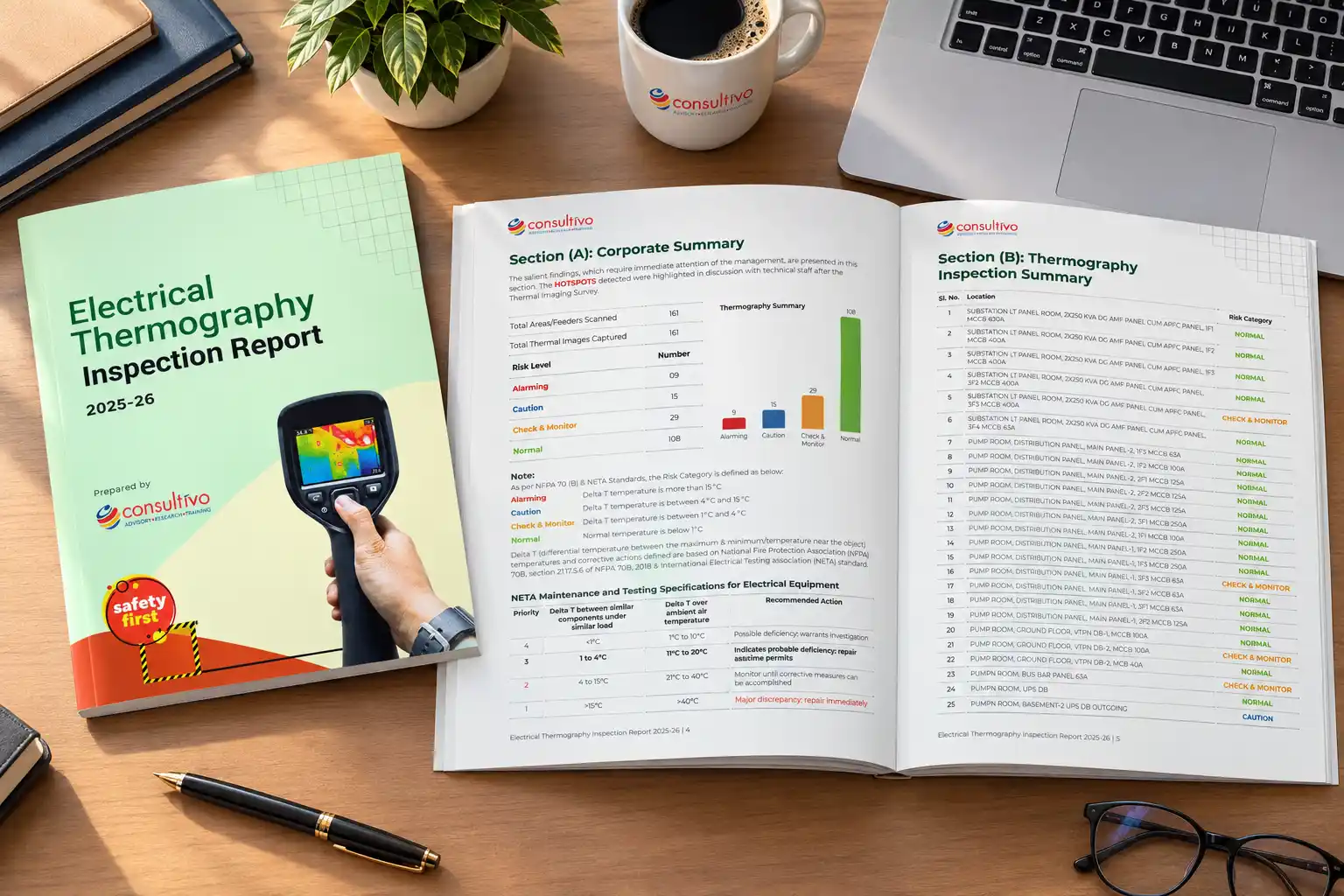
A draft risk-based report with thermal images, Delta T ratings and recommendations, then the final report after your inputs.
This survey supports your wider electrical safety audit and fire safety audit with data-based evidence.
Severity Rating
How We Rate Severity: Delta T Criteria
We rate each hot spot by Delta T, the temperature rise of the exception above a reference (a similar component under the same load, or the ambient air), following NETA Table 100.18.
| Delta T over similar component | Delta T over ambient | Suggested action |
|---|---|---|
| 1 C to 3 C | 1 C to 10 C | Possible deficiency, warrants investigation |
| 4 C to 15 C | 11 C to 20 C | Probable deficiency, repair as time permits |
| n/a | 21 C to 40 C | Monitor until corrective measures can be done |
| Over 15 C | Over 40 C | Major discrepancy, repair immediately |
Delta T is a temperature rise above a reference, not an absolute temperature. The right reference matters more than the raw reading.
At a Glance
Thermography at a Glance
Purpose
Identify and document exceptions (abnormally high temperatures) within electrical distribution systems and rotating equipment.
Indicator
Delta T (temperature difference), used to rate the severity of an exception.
Common Causes
Electrical: deteriorated or loose connections, short circuits, overloads, load imbalances, faulty or wrongly installed components. Rotating equipment: friction, misalignment, worn components or loading anomalies.
Instrument
Calibrated, radiometric infrared cameras with a spectral range of 2 to 14 micron and a minimum resolvable temperature difference of 0.3 C or better. A spot radiometer or non-imaging line scanner is not sufficient.
Thermographer
Preferably an electrical engineer with a certified thermographer qualification and competence.
Benefits
Objective severity rating, early detection of electrical-fire risk, and safety for people, equipment and the workplace.
Standards and Codes
Standards and Codes We Work To
- NFPA 70B (2023), annual infrared inspection and Delta T documentation
- NFPA 70E, Standard for Electrical Safety in the Workplace
- NETA Table 100.18, suggested actions by temperature rise
- ASTM E1934 and ISO 18434, infrared inspection and condition monitoring
- OSHA 29 CFR, and ANSI, IEEE and NEMA temperature limits where relevant
Frequency
How Often Should Thermography Testing Be Done
For most electrical panels and systems, carry out thermography testing every 12 months, and more often where conditions are harsh (wet, humid or corrosive) or where nodes fail repeatedly. Under NFPA 70B (2023), annual infrared inspection is now the benchmark, and many insurers require a yearly survey for policy renewal.
Who It Is For
Who Needs Thermography Testing
The Deliverable
Inside Your Thermography Report
- Scope and Method. Equipment covered, loading and reference basis.
- Exception Log. Each hot spot with thermal and visual images.
- Delta T Rating. Severity for each exception, per NETA criteria.
- Root-Cause Notes. The likely cause of each hot spot.
- Recommendations. Prioritised, with the suggested action and urgency.
- Evidence Pack. Annotated infrared and photographic images.

Better Together
Thermography Strengthens Your Safety Audits
Thermography testing is strongest as part of a wider assessment. It plugs directly into our electrical safety audit and fire safety audit, and it is a core component of our integrated fire and electrical safety package. Where explosive atmospheres are present, see also hazardous area classification.
The Safety Audit Framework
Start With the Three Essentials
The Hub
Comprehensive Safety Audit
The full, independent safety audit across every domain.
Explore the safety auditThe Protocol
ProtoSafe
The quantified safety maturity rating behind every audit.
Explore the safety assessmentThe Method
Safety Audit Methodology
The procedure, steps and report format we follow.
Explore safety auditing