
BRSR, or Business Responsibility and Sustainability Reporting, is India's mandatory ESG disclosure for the top 1000 listed companies by market capitalisation. The BRSR full form is Business Responsibility and Sustainability Reporting. It is filed within the annual report under SEBI's LODR Regulations, and it reports performance against the nine principles of the National Guidelines on Responsible Business Conduct (NGRBC). A focused subset, BRSR Core, must undergo third-party assessment or assurance on a phased timetable.
This guide is written for company secretaries, CFOs, sustainability leads and ESG teams preparing a BRSR report. It is current to 2026 and reflects SEBI's latest circulars. For the definitive text, always refer to the SEBI circular in force.
What Is BRSR or Business Responsibility and Sustainability Reporting?
BRSR stands for Business Responsibility and Sustainability Reporting. SEBI introduced the framework to make certain listed companies disclose their environmental, social and governance (ESG) performance in a standard, comparable format. It is the backbone of formal sustainability reporting for listed India.
BRSR is not just a data return. It is a structured way for a company to show how it manages its impact on the environment and society, and how it is governed, so that investors and other stakeholders can compare companies on the same basis.
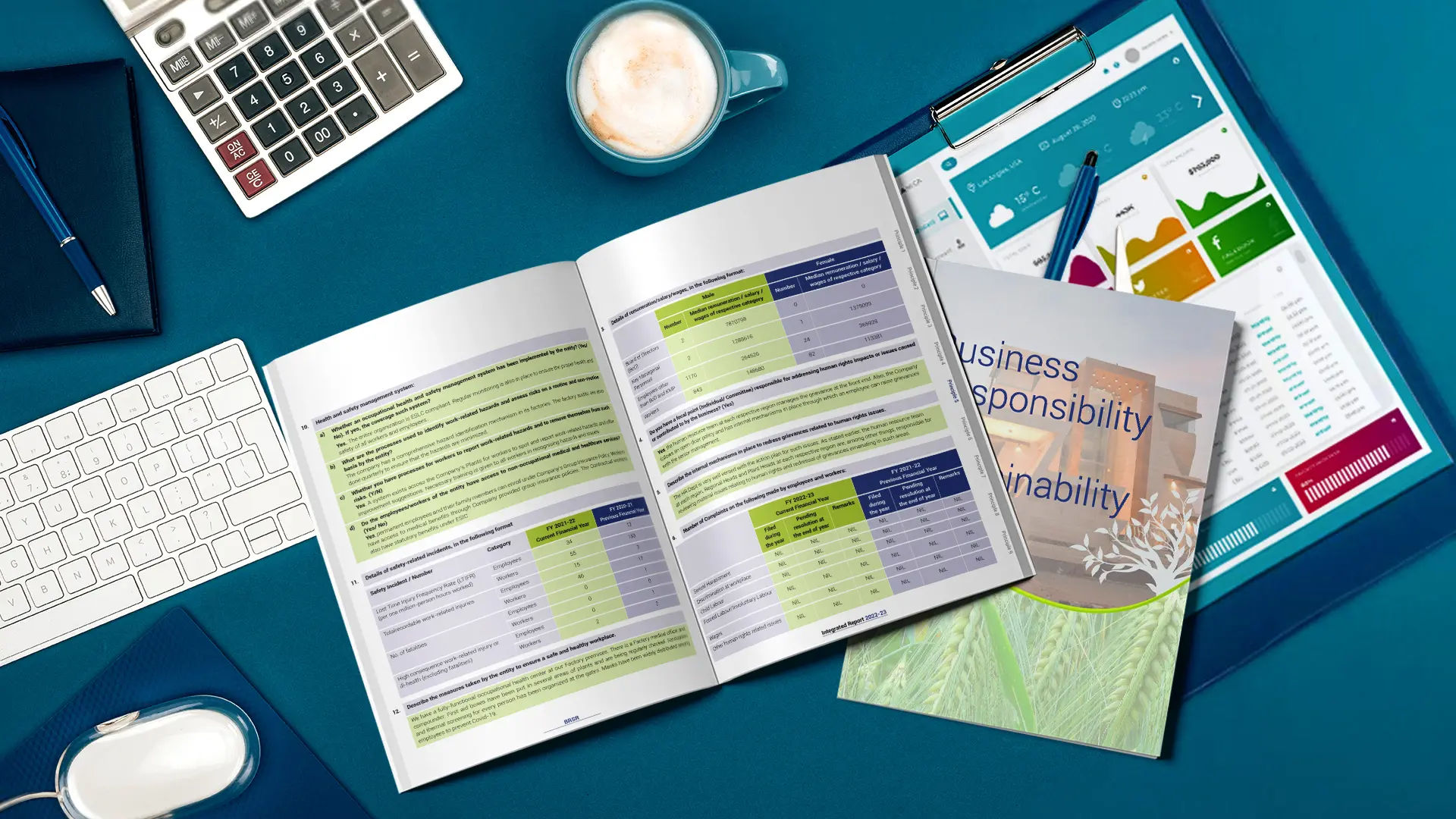
The purpose is straightforward. Standardised ESG disclosure lets investors identify sustainability-related risks and opportunities and make better decisions, and it lets companies demonstrate their sustainability position and progress. Higher standards of transparency help attract capital. This is the same discipline that sits behind good ESG consulting.
BRSR reporting seeks disclosures against the nine principles of the NGRBC. Reporting under each principle is split into essential indicators, which are mandatory, and leadership indicators, which are voluntary. Companies are encouraged to report the leadership indicators as well.
BRSR Full Form and Meaning
The BRSR full form is Business Responsibility and Sustainability Reporting. In a company context, the BRSR full form is the same: it is a reporting framework notified by SEBI for specified listed companies in India, filed as part of the annual report. So when someone asks what BRSR reporting is, the short answer is standardised ESG disclosure against the nine NGRBC principles.
Unlocking BRSR Reasonable Assurance: Explained for Every Business Leader
Explore BlogBRSR at a Glance
| Item | Position in 2026 |
|---|---|
| Who must file | Top 1000 listed entities by market capitalisation, taken as on 31 March |
| Where it is filed | Within the annual report, under SEBI LODR Regulation 34(2)(f) |
| Built on | The nine principles of the NGRBC |
| Structure | Section A (General), Section B (Management and Process), Section C (Principle-wise Performance) |
| Indicators | Essential (mandatory) and Leadership (voluntary but encouraged) |
| BRSR Core | A focused subset of ESG attributes that needs assessment or assurance |
| Assurance phase-in | Top 150, 250, 500 and 1000, across FY 2023-24 to FY 2026-27 |
| Value chain | Voluntary from FY 2025-26; partners at 2% or more, option to cover up to 75% |
| Green Credits | New leadership indicator under Principle 6, from FY 2024-25 |
BRSR Applicability: Is BRSR Mandatory and Who Must File?
Yes. BRSR is mandatory for the top 1000 listed entities in India by market capitalisation. BRSR applicability has covered these entities since FY 2022-23, and they file BRSR as part of the annual report. Market capitalisation is taken as on 31 March of the relevant year.
Are unlisted companies covered? Not yet. BRSR applicability is currently a listed-company requirement. A lighter, voluntary format, often called BRSR Lite, may be used by unlisted or smaller companies that wish to start reporting, and the framework could be extended in future based on thresholds of turnover or paid-up capital.
Can smaller or unlisted companies report voluntarily? Yes. Companies outside the top 1000 can adopt BRSR voluntarily, and many do so to meet investor, lender and customer expectations, or because they sit in the value chain of a large listed company. Preparing early often begins with an ESG due diligence services exercise to baseline current data.
Explore our Supplier ESG and BRSR Value Chain Assessment
Explore Value Chain
BRSR vs BRR: How BRSR Came About
Sustainability reporting gives a picture of a company's economic, environmental and social impact. SEBI was an early adopter among global peers. ESG-style disclosure for listed entities began in 2012 with the Business Responsibility Report (BRR).
The shift from BRSR vs BRR is a shift in rigour. In 2019, the Ministry of Corporate Affairs issued the National Guidelines on Responsible Business Conduct (NGRBC). In 2020, an MCA committee recommended replacing the BRR with a stronger, more quantitative format, the BRSR, to bring Indian disclosure in line with global practice. SEBI BRSR rules then made the framework mandatory for the top 1000 listed entities from FY 2022-23.
The Nine NGRBC Principles Behind BRSR
The BRSR 9 principles are the nine principles of the NGRBC. Each principle carries essential indicators (mandatory) and leadership indicators (voluntary), and each maps to the UN Sustainable Development Goals.
Master SEBI’s BRSR Framework with Confidence
Enroll in BRSR Training| Principle | In Plain English |
|---|---|
| P1 | Conduct business with integrity, transparency and accountability |
| P2 | Provide goods and services that are safe and sustainable |
| P3 | Respect and support the wellbeing of employees, including value chain workers |
| P4 | Respect the interests of, and be responsive to, all stakeholders |
| P5 | Respect and promote human rights |
| P6 | Protect and restore the environment |
| P7 | Engage in policy advocacy responsibly and transparently |
| P8 | Support inclusive growth and equitable development |
| P9 | Engage with and provide value to consumers responsibly |
BRSR Format: Sections A, B and C
The BRSR report format is structured into three sections.
- Section A - General Disclosures. The basics: who the company is, what it does, its structure, its operations, and its reporting boundary.
- Section B - Management and Process Disclosures. The policies, governance and systems behind each of the nine principles.
- Section C - Principle-wise Performance Disclosures. The heart of the report: performance data against each principle, split into essential and leadership indicators.
The official BRSR report format PDF, along with the BRSR Core format, is published by SEBI within the LODR Master Circular and the BRSR Core circular. Building the systems behind that data is where an ESMS earns its keep.
BRSR Core and Assessment or Assurance
BRSR Core is the part SEBI wants independently checked. It is a focused subset of ESG attributes, drawn from the full BRSR, chosen because they matter most to credibility and comparability. Since the March 2025 circular, companies may choose assessment or assurance for BRSR Core, where assessment follows the standards of the Industry Standards Forum (ISF) and assurance means an independent assurance engagement. We explain the detail in our dedicated guide to BRSR Core.
Ready for assessment or assurance? See how reasonable assurance holds up to scrutiny.
Talk to Our ESG Assurance TeamThe requirement arrives in phases by market capitalisation.
| Financial Year | BRSR Core Assessment or Assurance Applies To |
|---|---|
| 2023-24 | Top 150 listed entities |
| 2024-25 | Top 250 listed entities |
| 2025-26 | Top 500 listed entities |
| 2026-27 | Top 1000 listed entities |
Where a company chooses assurance, the standard is reasonable assurance. That is a higher bar than the limited assurance common in many other jurisdictions. Reasonable assurance tests source evidence, larger samples and the effectiveness of internal controls, and it ends in a positive opinion on the reliability of the data. That is why it rewards early preparation: the checker looks at the evidence trail, not just the totals. When you are ready for the engagement itself, our team provides independent ESG assurance.

Latest BRSR Guidelines and Updates You Need to Know (2026)
BRSR has changed a lot since it began. Here is the current position, drawn from SEBI's December 2024 board decision, the Industry Standards of 20 December 2024, and the easing circular of 28 March 2025. Together these form the working BRSR guidelines for the current cycle.
Assessment or Assurance, Not Assurance Only
For BRSR Core, "assurance" has been replaced with "assessment or assurance", giving companies a choice of a third-party assessment under ISF standards or an independent assurance engagement.
Value Chain Disclosures Eased and Deferred
Value chain ESG disclosure moved from comply-or-explain to voluntary. The scope narrowed to upstream and downstream partners that individually make up 2% or more of purchases or sales by value, with the option to cover up to 75% of total purchases and sales. Disclosure applies from FY 2025-26, and assessment or assurance of value chain data from FY 2026-27. Reporting prior-year data in the first year is voluntary. This applies to the top 250 listed entities.
Green Credits Added
A new leadership indicator under Principle 6 requires disclosure of Green Credits generated or procured by the company and its top 10 value chain partners, effective FY 2024-25.
Industry Standards and the BRSR Guidance Note
The ISF, made up of ASSOCHAM, FICCI and CII, issued Industry Standards, in effect a detailed BRSR guidance note, to standardise BRSR Core reporting, applicable from FY 2024-25. Part A covers general requirements, including PPP-adjusted and output-based intensity ratios and a spend-based approach where primary data is missing. Part B explains the requirements across all nine Core attributes, with clarifications on emission factors, water estimation, wage and POSH definitions, and CERT-In cyber incident reporting.
How BRSR Maps to Global Frameworks
A common question is whether BRSR duplicates a company's other reporting. It does not have to. BRSR is designed to interoperate with global frameworks, so one well-built data set can serve several of them. This is the same logic behind good sustainability reporting across frameworks.
| Framework | Focus | Geography | Relationship to BRSR |
|---|---|---|---|
| BRSR | ESG disclosure for listed entities | India | The mandatory Indian framework |
| GRI | Impact on people and environment | Global | Maps closely; SEBI and GRI issued linkage guidance |
| ISSB (IFRS S1 and S2) | Investor-focused sustainability and climate | Global | The emerging global baseline; absorbed TCFD and SASB |
| SASB | Sector-specific financial metrics | Global | Now within the ISSB standards |
| TCFD | Climate risk | Global | Now embedded in IFRS S2 |
| ESRS / CSRD | Double materiality | EU | Relevant for India-EU groups; interoperable core |
| CDP | Climate, water, forests | Global | Feeds ratings; overlaps with BRSR environment data |
| GHG Protocol | Emissions accounting | Global | The method behind Scope 1, 2 and 3 figures |
| UN SDGs | Global goals | Global | The nine NGRBC principles align to the SDGs |
Companies already reporting under GRI or the ISSB's IFRS S1 and S2 may cross-refer those disclosures to BRSR to avoid repeating work.
Not sure which disclosures matter most for your business? Baseline it first.
ESG Materiality Assessment
Practical Preparation
How to Prepare a BRSR Report: The 10-Step Roadmap
Most BRSR reports do not fail on writing. They fail on data ownership and evidence. This roadmap puts the hard part first.
- Leadership commitment. Get board and management sponsorship and name a project owner.
- Gap assessment. Compare current disclosures against the BRSR format and find the gaps.
- Materiality. Confirm the ESG issues that matter most through an ESG materiality assessment.
- Assign data owners. Give every indicator a single accountable owner.
- Evidence collection. Gather source data with a clear trail, across sites and functions.
- Data validation. Check definitions, units and consistency, and reconcile with the financials.
- Draft Sections A, B and C. Write essential indicators first, then leadership indicators.
- Internal review. Test the report the way an assessor or assurer would.
- Board and committee approval. Secure sign-off through the right governance route.
- File and publish. Include BRSR in the annual report and publish the report.
The full roadmap, with owners and timings for each step, is in the Company Secretary BRSR Handbook. If you want hands-on help, see our BRSR reporting services, or upskill your team through BRSR training.
Ownership
Who Does What: Department Responsibilities (RACI)
BRSR data lives all over the company. This is the fastest way to see who owns what.
| Data Area | Typical Owner |
|---|---|
| Emissions, energy, water, waste | EHS / Sustainability |
| Workforce, diversity, wages, POSH, wellbeing | HR |
| Supplier and customer data, value chain | Procurement |
| Community programmes, CSR spend | CSR |
| Revenue, financial base for PPP intensity | Finance |
| Policies, cyber incidents (CERT-In), grievances | Legal / IT |
| Board approval, filing and sign-off | Company Secretary |
BRSR Preparation Timeline
A workable calendar for a first-time or maturing filer, counting back from the annual report.
- Months 1 to 2: Leadership sign-off, gap assessment, materiality, assign owners.
- Months 2 to 4: Evidence collection and data validation across sites and functions.
- Months 4 to 5: Draft Sections A, B and C, and prepare for assessment or assurance.
- Month 5: Internal review, then assessment or assurance of BRSR Core.
- Month 6: Board and committee approval, filing within the annual report, publication.
Avoid These
Common BRSR Mistakes and How to Avoid Them
The same problems appear again and again.

Questions, Answered
BRSR Frequently Asked Questions
What Is the Full Form of BRSR?
What Is BRSR Applicability?
Is BRSR Mandatory?
What Is the Difference Between BRSR and BRR?
Can an Unlisted Company Prepare BRSR?
Does BRSR Require Assurance?
Can BRSR Replace a GRI Report?
Who Signs the BRSR?
How Long Does First-Time BRSR Preparation Take?
Are Scope 3 or Value Chain Emissions Required?
Where Can I Find the BRSR Report Format PDF?
What Is BRSR Core?
What Are Green Credits in BRSR?